Salesforce Is Finally Dead
When your phone system records, transcribes, summarizes, and tags every call automatically, you don't need a CRM to tell you what happened. You have the conversation itself searchable, structured, and attached to the contact before anyone lifts a finger. This is what we're building at Tonet.
The industry blames training and adoption. But the product never worked, and AI just made it obsolete.
The CRM industry has spent 30 years solving the wrong problem. They keep asking "how do we get people to enter data?" The right question was always "how do we stop requiring them to?"
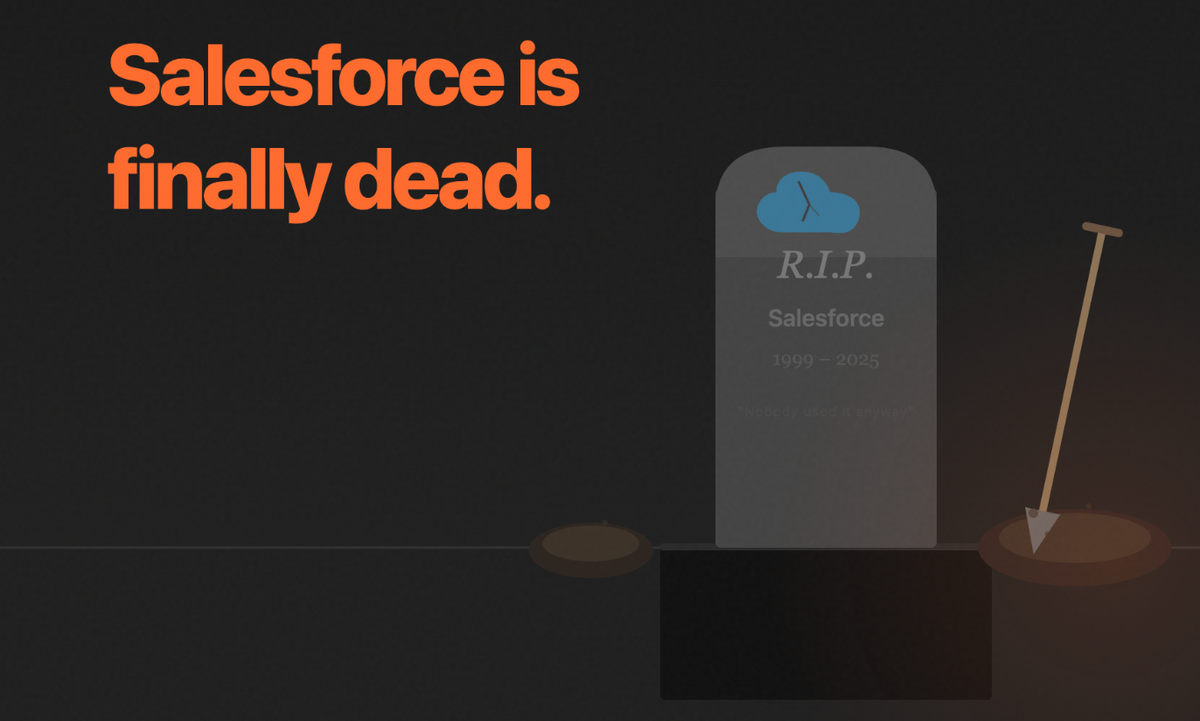
A 300 Billion Dollar ecosystem is slowly going out of business. The writing is on the wall, but the big players are slow to react. That is why Salesforce rolls out failed attempts at clinging on such as the infamous Einstein.
The future is here! and we're part of it!
But they're not. and they know it.
And every few years, the failure rates stay exactly where they've been since the '90s somewhere between 40% and 70%.
The official explanation is always the same:
- Your team didn't adopt it
- You didn't train enough
- Leadership didn't buy in
Translation: It's your fault the product doesn't work.
Here's what nobody in the CRM industry will say out loud: these systems don't fail because people use them wrong. They fail because they require people to use them and use them a lot. And use them strictly, or the data stops making sense.
The architecture problem nobody talks about
Every CRM ever shipped has the same fundamental flaw: it's an empty database that does nothing until a human feeds it. No input? No value.
Salesforce, HubSpot, Pipedrive. They're all the same. Stop what you're doing, open a form, and accurately log what just happened.
It is no surprise that:
- 40% of sales reps still track deals in spreadsheets and email.
- A third of account managers spend over an hour a day on manual data entry.
- Reps spend just 18% of their working hours actually inside the CRM.
This is why the "adoption problem" framing is such a con. It puts the blame on the user. Your reps are lazy. Your managers didn't enforce it. You should've bought more training hours. But no amount of training fixes a system that fundamentally asks people to do work that doesn't benefit them. CRMs were built for managers who want reports, not for the people on the phone actually closing deals.
Output-first already exists. You're just not calling it a CRM.
We're in the age of AI, and while every company out there is trying to get a small piece of the pie, our bet is the data will live somewhere in between the communication provider (us) and the LLM provider (Claude). With the CRM layer being slowly but surely eradicated.
No fields. No forms. No "remember to log this in Salesforce before your manager yells at you." The call itself becomes the data.
Every promise the CRM industry has been selling for decades: A single source of truth, a complete customer history, no more lost context.. Will finally all be delivered.
The irony is that Salesforce sees this coming. That's why they bought Slack, why they keep slapping AI on everything, why every CRM vendor is scrambling to add AI features. But bolting AI onto an input-dependent system doesn't make it output-first. It makes it an input-dependent system with a chatbot.
The phone system is the CRM now.
Here's what's funny about all of this. The CRM industry spent decades trying to capture what happens on phone calls. They built fields, forms, pipelines, stages, dropdowns an entire bureaucracy designed to approximate a conversation that already happened. And the best they ever got was a three-line note that says "Spoke w/ James. Interested. Follow up Monday."
That's changing. When your phone system records, transcribes, summarizes, and tags every call automatically, you don't need a CRM to tell you what happened. You have the conversation itself searchable, structured, and attached to the contact before anyone lifts a finger.
This is what we're building at Tonet. Not another CRM. Not an AI add-on you bolt onto Salesforce and pray your team uses. A business phone system where the call is the record, the transcript is the notes, and the summary is the pipeline update. Your team just picks up the phone and does their job. Everything else happens on its own.
The CRM industry won't frame it this way, because admitting the problem is architectural means admitting the product is the problem. So they'll keep selling training packages, adoption consultants, and AI features that still require someone to open a form first.
But if you're a 10-person team, a 50-person company, or honestly anyone who's tired of paying for software that only works when you do its homework the answer was never a better CRM.