The 30-Second Rule: Why Speed-to-Answer Decides Who Gets the Sale
When two businesses offer the same service at the same price, the one that picks up the phone first almost always wins. The research on response time is brutal, and most small businesses are on the wrong side of it.
Picture this. A homeowner's water heater just died. It's 9 AM on a Tuesday. They search "water heater repair near me," open three tabs, and start calling. The first company picks up on the second ring. Friendly voice, books an appointment for this afternoon. Done.
The second company? Their phone rang six times and went to voicemail. The third company's auto-attendant looped them through three menus before disconnecting.
Those two businesses never had a chance. The job was gone before they even knew it existed.
This plays out thousands of times a day in every service industry. Not because one company is better than another, but because one company was faster.
The Data Is Pretty Clear
A widely cited Harvard Business Review study looked at 1.25 million sales leads and found that businesses responding within five minutes were 21 times more likely to qualify the lead than those who waited 30 minutes [1]. Not slightly more likely. Twenty-one times.
The same research showed that after just one hour, your odds of making meaningful contact drop off a cliff. And yet the average response time for B2B companies in the study was 42 hours. Almost two full days.
For inbound phone calls, the stakes are even higher because the customer is actively trying to reach you right now. They have their wallet out. They're ready to buy. All you have to do is answer.
A Forrester survey found that 73% of customers say valuing their time is the most important thing a company can do during a service interaction [2]. Nothing communicates "we don't value your time" like making someone wait.
Why 30 Seconds Matters
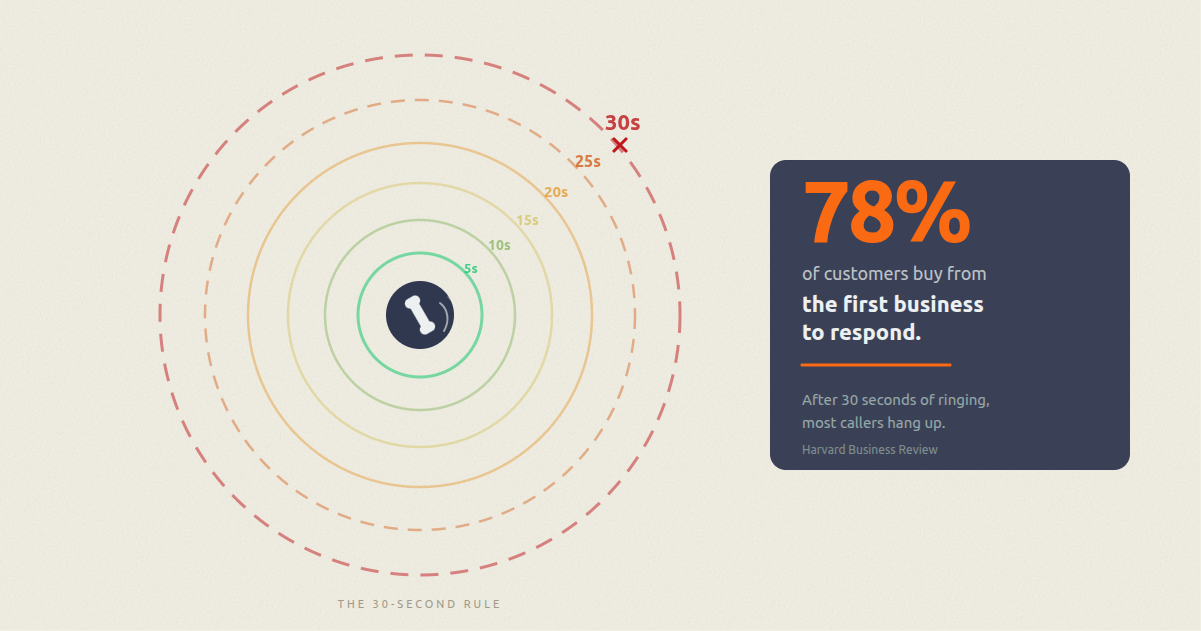
Most callers will hang up after about 30 seconds of ringing. Some studies put the threshold even lower. A survey by Velaro found that nearly 60% of callers won't wait on hold for more than one minute, and a third won't wait at all [3].
Thirty seconds. That's your window.
Think about your own behavior. When you call a restaurant to make a reservation and nobody picks up after five or six rings, do you wait? Or do you just call the next place on the list?
Your customers do the same thing. And they're not mad about it. They don't write angry reviews or send complaint emails. They just quietly disappear and give their money to whoever picks up.
The First-Responder Advantage
There's a psychological principle at work here that goes beyond convenience. The first business to make contact earns a trust advantage that's hard for competitors to overcome.
When a customer reaches out and gets an immediate response, two things happen. First, they feel heard. The basic human need for acknowledgment kicks in, and your business just satisfied it. Second, they anchor on you. You become the default option, and every subsequent business they talk to gets compared against the experience you already provided.
Lead Connect research found that 78% of customers buy from the first business to respond to their inquiry [4]. Not the cheapest. Not the one with the best reviews. The first one to answer.
That's a massive competitive advantage that has nothing to do with your product, your pricing, or your marketing budget. It's just about picking up the phone.
Where Small Businesses Lose
Big companies throw bodies at this problem. They have call centers, dedicated receptionists, overflow queues. A five-person team doesn't have that luxury. So calls get missed during lunch, during meetings, during the hundred small moments throughout the day when everyone's hands are full.
The most common failure points:
Ring groups that aren't set up right. The office phone rings, but nobody's at the desk. If there's no fallback to mobile phones, the call dies.
After-hours gaps. Your business might close at 5, but customers don't stop calling at 5. Without after-hours routing or a decent auto-attendant, those calls evaporate.
The "I'll call them back" trap. You see a missed call, make a mental note to return it, and then three hours pass. By the time you call back, they've already hired someone else.
No visibility. If you can't see how many calls you're missing, when they're happening, and how long people waited, you can't fix the problem. You don't even know it exists.
Fixing It Doesn't Require Hiring Anyone
The instinct is to think you need more staff to answer faster. You don't. You need a system.
Simultaneous ring sends incoming calls to multiple team members at once. Whoever's available picks up first. The caller doesn't know they were routed anywhere. They just know someone answered quickly.
Auto-attendants buy you time. A professional greeting that says "thanks for calling, let me connect you" keeps the caller engaged for those critical seconds while the system finds an available person. It's infinitely better than dead air or an endless ring.
Mobile fallback means the call follows your team wherever they are. Not at your desk? It hits your cell phone. Not available at all? It goes to someone else on the team. The call doesn't stop until someone answers or it reaches a voicemail that actually gets transcribed and sent to you immediately.
Call analytics let you spot the patterns. Maybe you're missing 40% of calls between noon and 1 PM. Maybe Thursdays are your worst day. Once you see it, you can staff for it.
At Tonet, we built all of this into the phone system because we watched small businesses lose customers over and over to the same problem. Not bad service, not bad products. Just slow phones.
The 30-Second Audit
Try this right now. Pull up your call data from the last two weeks. Answer three questions:
- How many calls rang more than 30 seconds before being answered? Each one of those was a customer whose patience was being tested.
- How many calls went to voicemail? Now check how many of those voicemails were returned within 5 minutes. If the answer is "almost none," you know where your leads are going.
- What's your average speed-to-answer? If it's over 15 seconds, you're leaving money on the table.
If your phone system can't tell you these numbers, that's the first thing to fix.
Speed Is the Simplest Competitive Advantage
You can't always be cheaper than your competitors. You can't always have better reviews or a fancier website. But you can always be the one who picks up the phone.
Seventy-eight percent of customers choose the first responder. Your marketing drives people to call you. Your speed-to-answer determines whether that marketing investment pays off or gets handed to the competitor who answered faster.
The 30-second rule isn't complicated. When the phone rings, answer it. When you can't answer it, make sure someone or something else does. When a call slips through, call back within minutes, not hours.
The businesses that grow fastest aren't always the ones with the best product. They're the ones that pick up.
Ready to stop losing customers to slow answers? Set up simultaneous ring, auto-attendant, and mobile fallback in under 10 minutes. Try Tonet
Sources:
[1] James B. Oldroyd, Kristina McElheran, and David Elkington, "The Short Life of Online Sales Leads," Harvard Business Review (March 2011). Study of 1.25 million sales leads across 29 B2C and 13 B2B companies.
[2] Forrester Research, "Customer Experience Index" (2023). Survey of over 90,000 U.S. customers across industries.
[3] Velaro, "How Long Will Customers Wait on Hold?" (2012). Survey of U.S. consumers on hold time tolerance.
[4] Lead Connect, "Speed to Lead: 78% of Customers Buy From the First Responder" (2019). Analysis of inbound lead response and conversion data.