What Your Missed Calls Are Actually Costing You
Most small businesses miss more calls than they realize. Every one of those calls is a potential customer who moved on to the next option. Here's how to figure out what it's actually costing you and what to do about it.
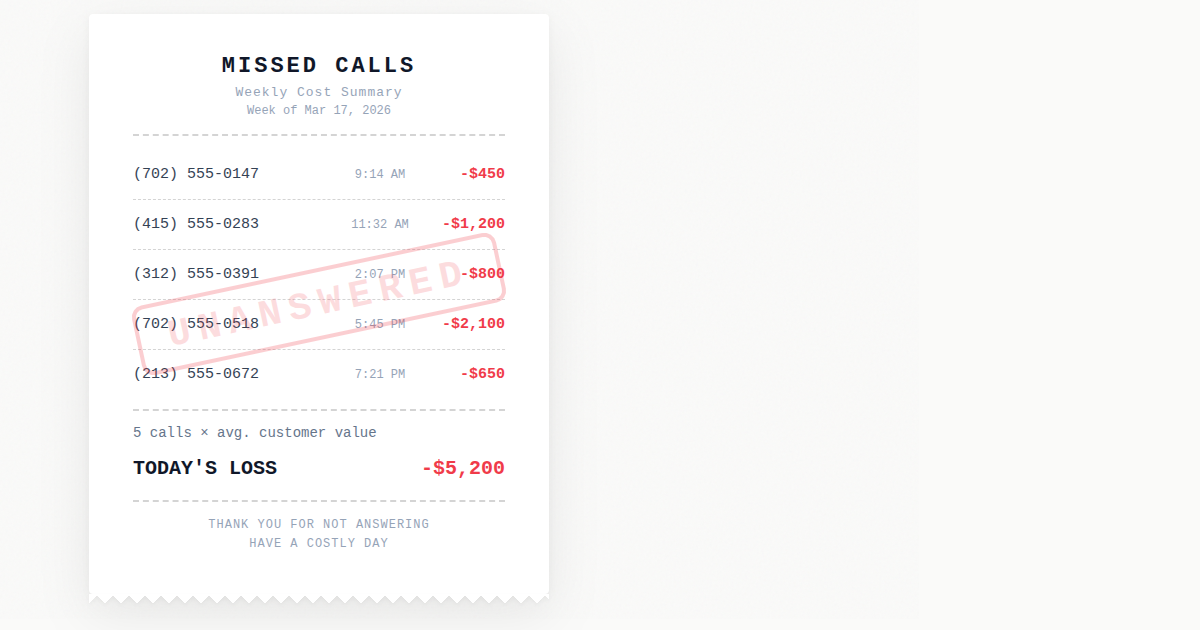
Here's a number that should bother you: 62% of calls to small businesses go unanswered [1]. Not voicemail. Not "let me call you back." Just... nothing. The phone rings, nobody picks up, and the caller moves on with their life.
And by "moves on," I mean they call your competitor.
If you run a business where customers call you, every missed call has a dollar amount attached to it. Not a theoretical one. A real one. And most business owners have never done the math.
Let's do it right now.
The Quick and Dirty Calculation
This takes about 60 seconds. Pull up your call history or phone system dashboard. You need three numbers:
- How many calls you miss per week. Include after-hours calls, calls that went to voicemail but never got returned, and calls during lunch breaks when nobody's at the desk.
- What percentage of your inbound calls are potential customers. For most service businesses, it's somewhere between 40% and 70%. The rest are spam, vendors, and your mom.
- Your average customer value. What's a typical customer worth over their first year? Not lifetime value, just year one.
Now multiply. If you miss 20 calls a week, and half are potential customers, that's 10 leads walking away. If your average customer is worth $2,000, you're looking at $20,000 in missed revenue. Per week.
Run those numbers annually and try not to wince.
Why Calls Get Missed
It's rarely one big problem. It's a bunch of small ones stacking up.
Nobody's assigned to answer. In a small team, everyone's doing three jobs. The phone rings during a meeting, during lunch, during a conversation with a customer who's already standing in front of you. Nobody's "the phone person" because everybody's everything.
After-hours calls disappear. Your business closes at 5. Your customers don't stop having problems at 5. That plumbing emergency, that insurance question, that catering inquiry for this weekend. Those calls come in at 7 PM and sit in a voicemail box that nobody checks until tomorrow. By then, the customer found someone who answered.
Voicemail is a dead end. Most callers who hit voicemail just hang up. They don't leave a message, they don't call back, they just try the next business on their list. If your missed call strategy is "they'll leave a message," your missed call strategy is "lose the customer."
You don't know it's happening. This is the sneaky one. If you don't have visibility into your call data, you don't know what you're missing. You can't feel the revenue you never earned. There's no alert that says "hey, you just lost a $5,000 job because nobody picked up at 2:15 PM on Tuesday."
The Calls That Hurt the Most
Not all missed calls are created equal. Some matter way more than others.
First-time callers. Someone who's never done business with you is calling because they have an immediate need. They probably searched for your type of business, saw a few options, and started dialing. If you don't answer, they call the next one. You never even knew they existed.
A BrightLocal survey found that 60% of consumers prefer to call a local business after finding them through search [2]. That first call is your shot. Miss it and you lose to the business that picked up.
Warm leads. Someone who got your name from a referral or clicked through from your website. They're already leaning toward you. All you had to do was answer. But you didn't, and now they're questioning whether you're reliable.
Existing customers with urgent issues. These calls don't lose you a sale today. They lose you a customer for life. Someone calls with a problem, gets no answer, gets frustrated, and starts looking for a replacement. Research from Bain & Company shows that acquiring a new customer costs anywhere from 5 to 25 times more than keeping one you already have [3]. Letting a $10,000 annual client walk because nobody answered a Tuesday afternoon call is an expensive mistake.
What "Answering" Actually Means in 2026
You don't need someone sitting by a phone eight hours a day. That's not realistic for a five-person team. But you do need a system that makes sure no call goes into the void.
Auto-attendants handle the first touch. A professional greeting that routes callers to the right person or department. It doesn't replace a human, but it buys you 30 seconds and keeps the caller engaged instead of hanging up.
Call routing sends calls where they need to go. Not just to the office desk that nobody's sitting at. To mobile phones, to team members who are actually available, to whoever can pick up right now.
Voicemail-to-text means you actually read your messages. Let's be honest. Nobody listens to voicemail anymore. But a text transcription that hits your phone instantly? You'll read that in 10 seconds and call back in 2 minutes instead of 2 hours.
After-hours routing keeps you covered. Set it and forget it. Calls after 6 PM go to a different greeting, a different flow, maybe a different team member. The caller doesn't know your office is closed. They just know someone's handling their call.
Call analytics show you the blind spots. When are calls peaking? When are they getting missed? Which team members are picking up and which aren't? You can't fix what you can't see.
The Speed Factor
It's not just about answering. It's about how fast.
A Harvard Business Review study analyzed 1.25 million sales leads and found that companies who responded within an hour were seven times more likely to qualify the lead than those who waited even one hour longer, and more than 60 times more likely than companies that waited 24 hours [4]. The first business to respond has a massive advantage.
If you can return a missed call within 5 minutes instead of 5 hours, your close rate goes up dramatically. If you can avoid missing it in the first place, even better.
Start With the Numbers
Here's what I'd do this week. Go look at your missed calls from the last 30 days. Most phone systems can show you this. If yours can't, that's a problem worth solving on its own.
Count them up. Run the math from earlier. Even if your estimates are rough, the number will be uncomfortable enough to make you take action.
Then ask yourself three questions:
- What happens when someone calls us outside business hours?
- What happens when all our team members are busy?
- How quickly do we return missed calls?
If you don't have good answers, the fix isn't complicated. A modern phone system with call routing, auto-attendant, and voicemail transcription solves most of this overnight. At Tonet, we built this specifically for small teams that can't afford to miss calls but also can't afford to hire a receptionist. It takes about 10 minutes to set up.
The math on missed calls is brutal. But it also means the upside of just answering the phone is massive. Every call you catch that you used to miss is potential revenue recovered.
Stop letting your phone ring into the void. The customers calling you right now won't call twice.
What's your system for handling missed calls? We'd love to hear what's working (or not working) for your team.
Sources:
[1] 411 Locals, "Small Business Owners Don't Answer 62% of Phone Calls"
[2] BrightLocal, "Local Business Websites and Google My Business Comparison Report"
[3] Frederick Reichheld, Bain & Company, Harvard Business Review, "The Value of Keeping the Right Customers"
[4] James B. Oldroyd, Kristina McElheran, and David Elkington, Harvard Business Review "The Short Life of Online Sales Leads,"