Your Phone Provider Is Hiding Your Failed Calls
When an outgoing call fails, some phone providers just hide it. No error, no reason, nothing in your call log. The FCC finally has something to say about that.
You dial a prospect. Maybe you hear a ring or two before it drops. Maybe it sounds like a normal hangup. Either way, you move on to the next number and never think about it again.
Here's the thing: that call failed. The destination carrier blocked it, or the number was disconnected, or the line was busy. But your phone system didn't tell you any of that. It just logged it as another regular unanswered call, or didn't log it at all.
This is more common than you think. And it's been costing businesses real money.
The Problem Nobody Talks About
Most business phone providers treat failed calls as noise. The call didn't connect, so they don't show it. Or they label it "Missed" and move on with no further explanation. From the user's perspective, they just see fewer completed calls in their dashboard and wonder why their numbers are down.
But there's a big difference between a call that wasn't answered and a call that was actively blocked. One means the person was busy. The other might mean your caller ID has been flagged, your number has a bad reputation with a specific carrier, or you're dialing a disconnected line over and over without knowing it.
When your provider hides this information, you lose the ability to act on it. You can't fix what you can't see.
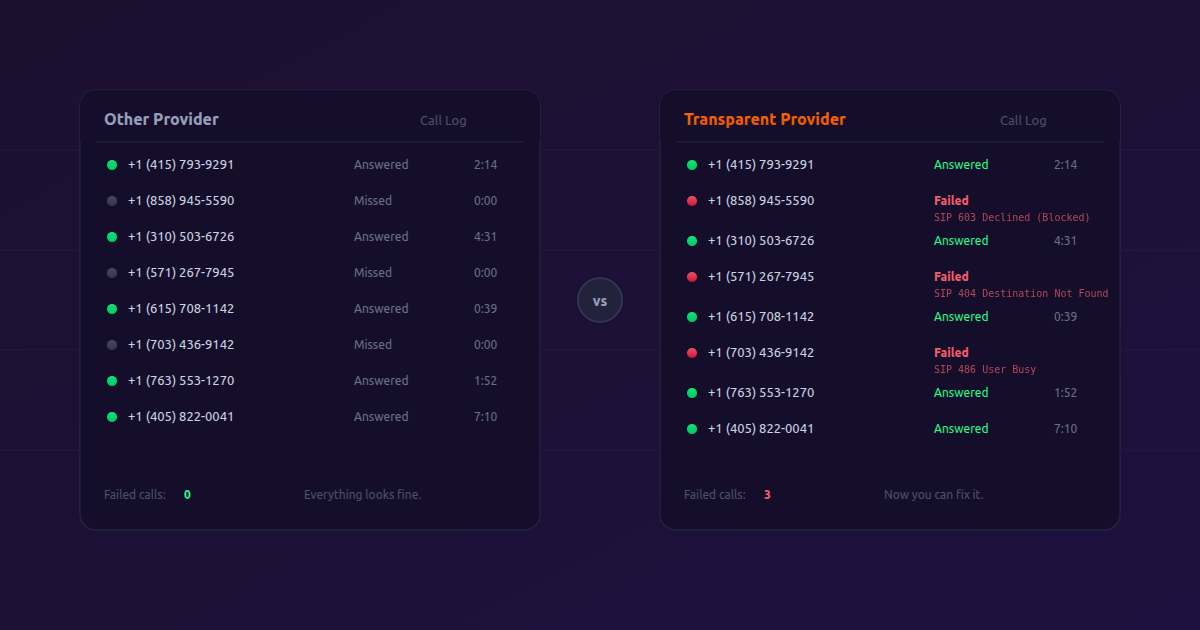
We recently did a side-by-side comparison for a customer who was testing two phone providers at the same time. Their other provider showed zero failed calls across thousands of outgoing dials. Zero. Every call was either "Answered" or "Missed." No failures, no errors, no blocked calls.
That's not transparency. That's a magic trick.
When we pulled the same provider's detailed call leg data, the failures were there the whole time. Nearly 10% of their outgoing calls never connected. The system just never told anyone.
On our end, every failed call showed exactly what happened: "SIP 404 Destination Not Found" for disconnected numbers, "SIP 603 Network Blocked" when a carrier's analytics flagged and blocked the call, "SIP 486 User Busy" when the line was occupied. The customer saw our red "Failed" labels and assumed we had a problem. The other provider showed a clean log and looked flawless.
Same calls. Same outcomes. One provider showed them. One didn't.
The FCC Agrees: Hiding Is Not Okay
As of March 2026, the FCC's SIP 603+ mandate is fully in effect. The rule requires terminating carriers to return a standardized "603+" response code whenever they block a call based on analytics. That code tells the originating provider exactly what happened: the call was blocked, who blocked it, and how to request a review.
Before this rule, carriers could block your calls silently. No notification, no explanation. Your call just vanished into a black hole. The TRACED Act changed that by requiring transparency, and the SIP 603+ standard is the enforcement mechanism.
This is a big deal for businesses that depend on outbound calling. If your number gets flagged, you need to know immediately so you can take action. Not three weeks later when you notice your callback rate dropped.
What Transparency Actually Looks Like
When a call fails, you should know three things: that it failed, why it failed, and whether there's anything you can do about it.
A disconnected number (SIP 404) means you should remove it from your list. A busy signal (SIP 486) means try again later. A service unavailable error (SIP 503), or Declined (603) might mean a carrier is temporarily blocking your traffic, and you need to check your caller ID reputation.
Each of these requires a different response. Lumping them all under "Missed" or hiding them entirely means your team wastes time redialing dead numbers, never realizes their caller ID is getting flagged, and can't troubleshoot routing issues.
It also means your call analytics are wrong. If your dashboard says you made 500 calls today and 400 were answered, that looks like an 80% connect rate. But if 75 of those calls actually failed before they reached anyone, your real connect rate is closer to 70%. You're making decisions based on incomplete data.
Why This Matters More Than You Think
For sales teams doing high-volume outbound calling, even a small percentage of hidden failures adds up fast. If 5% of your calls are silently blocked and you're making 1,000 calls a day, that's 50 prospects you think you reached but didn't. Over a month, that's over 1,000 missed opportunities that never show up in any report.
But it goes beyond lost calls. When your team sees clean logs with no failures, they assume everything is working perfectly. Problems with number reputation, carrier blocks, or routing issues go undetected until the damage is done. By the time someone notices the callback rate is dropping, you've already burned through a month of leads with a flagged number.
The businesses that catch these issues early are the ones whose phone systems actually tell them something went wrong.
The Uncomfortable Truth
There's a reason most providers hide failures. Clean logs look better. A dashboard full of successful calls makes the product feel reliable. Showing a red "Failed" label next to a SIP error code doesn't exactly scream "everything is fine."
But that's the trade-off between looking good and being useful. A phone system that hides problems from you isn't protecting you. It's just making it harder for you to do your job.
The FCC's new transparency rules exist because the industry spent years hiding this information from businesses. Now the regulation is catching up, and carriers are being forced to do what some providers have been doing all along: tell you the truth about your calls.
If your current phone provider can't show you why a call failed, it's worth asking what else they're not showing you.
Tonet shows every call outcome with full SIP-level detail, because your business decisions should be based on complete data. See how it works.