70% of Small Businesses Are Stuck in AI Limbo. Here's Why.
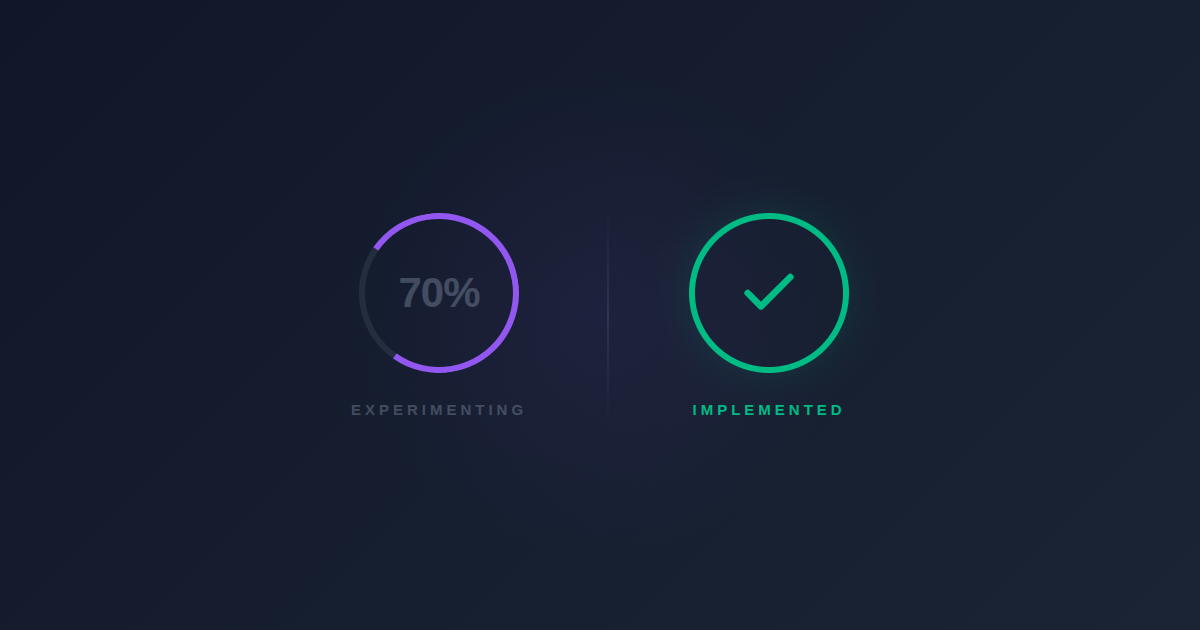
58% of small businesses say they're using AI. But 70% of them are stuck in the "experimental" phase. They're signing up for tools, running a few tests, and then quietly going back to doing everything the old way. The gap between trying AI and actually using it is where the real money disappears.
There's a stat going around right now that 58% of small businesses are using AI [1]. Sounds impressive. Sounds like the future already arrived.
Then you read the fine print.
A separate study from just last week found that nearly 70% of small and midsized businesses are still in the "experimental" or "opportunistic" phase of AI adoption [2]. That means they signed up for a few tools, maybe ran ChatGPT a handful of times, and then went back to doing things the way they always have.
So when 58% of small businesses say they're "using AI," what most of them really mean is: they tried it once.
The Subscription Graveyard
Every small business owner knows this feeling. You see a tool that promises to save you five hours a week. You sign up for the free trial. You spend 20 minutes poking around. Life gets busy. Two months later you notice the $29 charge on your credit card and cancel.
AI tools have supercharged this cycle. The past two years have produced an avalanche of products promising to automate everything from your email to your bookkeeping to your social media. Small businesses have increased AI investment by 58% in the past two years [1]. That's a lot of money flowing toward tools that, for most businesses, aren't actually changing how work gets done.
The problem isn't the tools. Most of them work fine. The problem is the space between signing up and actually building a workflow around it. That space is where 70% of businesses get stuck and quietly give up.
Why "Experimenting" Feels Like Progress
Experimenting is comfortable. You're technically doing something about AI. You can tell yourself you're keeping up. You can mention it at networking events. "Yeah, we're looking into AI for our operations."
But experimenting without implementing is just tourism. You visited the country, took some pictures, and flew home. Nothing changed.
The businesses that are actually getting results from AI aren't the ones trying the most tools. They're the ones that picked one or two specific problems, found a tool that solves them, and then forced themselves through the uncomfortable part: changing how they actually work day to day.
That's the part nobody wants to talk about. AI doesn't save you time by existing on your computer. It saves you time when you stop doing the old thing and start trusting the new thing. And that transition is awkward, slow, and feels less efficient for the first two weeks.
The Three Things That Actually Work
After watching small businesses throw money at every AI tool with a landing page, a pattern has emerged. The ones getting real ROI tend to land on the same three categories.
Log and data analysis, wired into your workflow. Every business generates data that piles up unread. Server logs, error reports, sales exports, support tickets. AI is shockingly good at making sense of this stuff. But the difference between experimenting and implementing is how it's connected. Experimenting is copying a log file into ChatGPT when something breaks. Implementing is having a Slack bot your team can ask "what errors spiked overnight" and it digs through your actual systems and answers in seconds. Or an automated summary of yesterday's support tickets waiting in your inbox every morning. The AI isn't a tool you go to. It's plugged into the places your team already works, surfacing answers before anyone thinks to ask.
Transcription and meeting notes. This is probably the single highest-ROI AI use case for small businesses right now. Record calls and meetings, get a transcript and summary automatically, stop spending 15 minutes after every call typing up what was said. If you're in sales, service, legal, or consulting, this one's a no-brainer. You get searchable records of every conversation without anyone taking notes.
Data cleanup and categorization. Small businesses drown in unstructured information. Customer inquiries in five different inboxes. Expense receipts in a shoebox. Lead lists that haven't been sorted since 2024. AI is genuinely good at taking a mess of text and organizing it into something usable. It's not glamorous, but it saves real hours.
Notice what's not on this list: chatbots on your website, AI-generated art for your Instagram, or automated cold outreach. Those are the tools that generate the most hype and the least actual value for a 10-person company.
The 89% Stat That Proves the Point
Here's the encouraging part. Among small businesses that are actually using AI (not just experimenting), 89% report a positive impact [1]. That's not "it was fine." That's nine out of ten saying it made a difference.
The gap between "tried it" and "use it" is where all the value lives. And it's not a technology gap. It's a commitment gap.
The businesses in the 89% aren't smarter. They didn't find some secret tool. They just picked a workflow, swapped in the AI version, tolerated the learning curve for a few weeks, and came out the other side with an extra hour in their day.
How to Get Unstuck
If you're in that 70% and you know it, here's the playbook. It's boring on purpose.
Step one: Pick one problem. Not "implement AI across the business." One specific pain point. "I spend 45 minutes a day writing follow-up emails." "Nobody takes notes in client meetings and we keep forgetting what was discussed." "Our expense tracking is a disaster." One thing.
Step two: Find the simplest tool that solves it. Not the most powerful. Not the one with the most features. The one that takes the least effort to start using tomorrow. If it requires a two-week onboarding process, it's the wrong tool for your first AI win.
Step three: Use it every single time for 30 days. This is the hard part and the only part that matters. Don't use it "when you remember." Don't use it "for the important stuff." Use it every time, even when it feels slower at first, even when the output isn't perfect. You're building a habit, not evaluating a product.
Step four: Measure it after 30 days. Not with fancy analytics. Just ask yourself: am I faster? Did I get time back? Would I go back to the old way? If the answer is yes, you just graduated from experimenting to implementing. Move on to problem number two.
The Real Risk Isn't Moving Too Slow
There's a lot of fear-based AI marketing right now. "Your competitors are using AI and you'll be left behind." That framing is mostly nonsense. Your 15-person plumbing company isn't going to go bankrupt because you haven't adopted an AI chatbot.
But here's what is real: the businesses that figure out AI workflows now are building a compounding advantage. Every month they use AI transcription, they have better records. Every week they use AI for drafts, they're a little faster. These aren't revolutionary changes. They're small efficiency gains that stack up.
The risk isn't that you'll be "left behind." The risk is that you'll spend two years signing up for AI tools, never actually using them, and then wonder where all that money went. That's what the 70% are doing right now.
Pick one problem. Fix it. Then pick another.
Sources:
[1] U.S. Chamber of Commerce / Teneo, "Small Business Index Q1 2026" (2026). Survey of 1,500+ small business owners on AI adoption, growth expectations, and technology investment.
[2] BenefitsPro, "70% of SMBs stuck in 'experimental' phase of AI adoption" (May 2026). Citing research on SMB AI maturity levels.