$7,900 Per Employee. That's What Your SaaS Stack Costs Now.
The average SMB now spends $7,900 per employee per year on software, and a quarter of that money buys nothing. The unbundling backlash is starting, and communication tools are one of the first things on the chopping block.
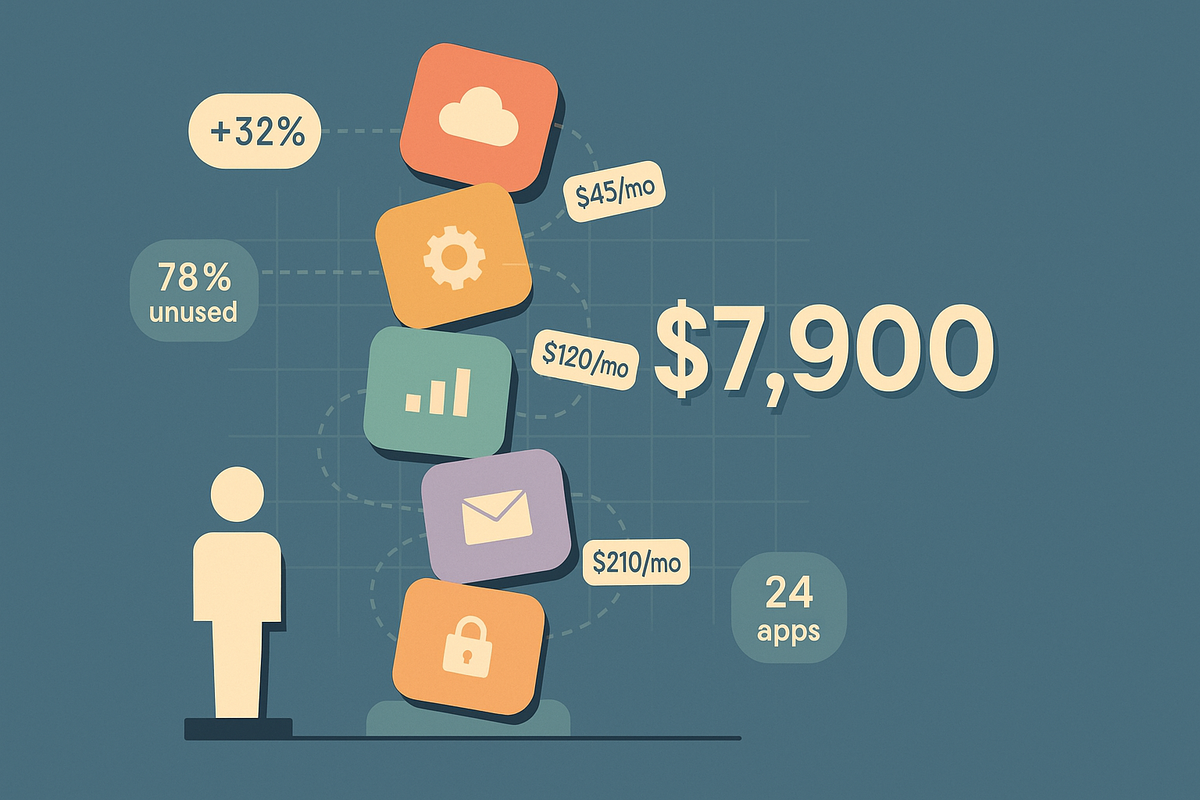
Pull up your company's list of active SaaS subscriptions. Count them. If you have not done this in the last year, the number will surprise you. If you have twenty employees, it will alarm you.
The average small and mid-sized business now spends around $7,900 per employee per year on software subscriptions. That figure jumped roughly 27% in two years [1][2]. Somewhere between a quarter and a third of that spend is going to licenses nobody uses, tools that overlap with three other tools, or free trials that quietly converted six months ago and never got flagged.
For a 15-person company, that is close to $120,000 a year in software. For a 50-person company, nearly $400,000. And here is the uncomfortable question. If you had to defend every line item to your bank tomorrow, how many could you actually justify?
How we got here
The pandemic taught every business a new instinct. See a problem, buy an app. Someone needs to share files, buy something. Someone needs to sign a contract, buy something. Someone wants a fancier calendar, buy something. It felt cheap because each individual subscription looked cheap. Twelve dollars a month here, twenty there, a free tier that only cost a credit card on file.
Nobody built a system for un-buying.
Meanwhile, most SaaS vendors moved to per-seat pricing and started raising rates every renewal cycle. Then AI features arrived and gave them permission to raise them again, often bundled into "premium" tiers whether you asked for them or not. Some now charge based on usage, so a tool that cost you $200 last quarter can cost $800 this quarter without anyone approving it [1].
The result is a stack that grew organically, was never audited, and now eats more than payroll growth in some businesses.
Where the waste actually lives
When companies finally do the audit, the pattern is boringly consistent. The biggest chunks of waste show up in four places.
Unused licenses. Someone left the company. Nobody told IT or ops. That seat is still billing. Multiply by every departure over three years.
Duplicate tools. Sales bought one CRM, marketing bought another. Support has three different chat platforms because each team lead picked their favorite. Everyone has a video conferencing tool, and everyone uses a different one for different meetings.
Zombie subscriptions. The tool a team piloted in 2024 and abandoned in 2025. Still charging. The annual contract that auto-renewed the day after the champion for it quit.
Feature overlap. You pay for a project management tool with built-in chat. You pay for a chat tool separately. You pay for a wiki that has task features. You pay for a task tool that has docs. Each vendor is trying to eat the other's lunch, and you are the one paying for the food fight.
Communication tools are one of the worst offenders. Look at what most SMBs actually run. A business phone provider. A separate video meeting platform. A separate SMS tool for marketing. A separate call recording add-on. A separate transcription service. A separate CRM that logs some of the interactions but not others. Six vendors, six bills, six admin panels, six passwords, and information trapped in silos between all of them.
The unbundling backlash
The tide has started to turn. Analysts tracking SaaS spend in 2026 report that a growing share of SMBs are cutting between 30% and 50% of their tool stack, either consolidating onto unified platforms or dropping subscriptions entirely [2] and going back to simpler workflows.
Part of this is just math. When budgets tighten and per-seat prices climb, the CFO starts asking questions that used to get waved off. Part of it is philosophical. Owners are tired of paying five vendors to do what one platform should. And part of it is practical. When your team has to open eight tabs to answer one customer question, you are not saving time with software. You are losing it.
Where to start if you are auditing
If you want to make a dent this quarter, do not try to solve everything. Do this instead.
Pull the last three months of your business credit card and bank statements. Highlight every recurring software charge. This alone will surface subscriptions you forgot existed.
For each tool, ask three questions. Who owns it. How many people actually opened it last month. What would break if we cancelled it tomorrow. If nobody can answer the first two, that is the answer.
Then look for overlap categories. Anywhere you are paying two or more vendors for the same job, pick one and consolidate. Communication is usually the easiest place to start because the overlap is so obvious. Phone, SMS, video, and call intelligence do not need to be four separate contracts.
Watch for the AI upsell trap. Every SaaS vendor is currently repackaging basic features as "AI-powered" and moving them into a higher tier. Before you approve the upgrade, check whether the AI actually does something useful for your workflow, or whether it is just autocomplete with a nicer logo.
Renegotiate at renewal. Vendors expect you to pay the sticker price. Most will discount 10 to 20% if you push, especially if you hint at consolidation. Ask.
The Tonet angle, briefly
We built Tonet because we watched this exact problem play out in businesses we knew. Phone bill from one vendor, texting from another, call recording bolted on for extra, CRM subscription piling on top, and none of it talking to each other. Our pricing runs $10 per user per month pay-as-you-go, or $15 flat for unlimited, billed daily so you only pay for the days you actually use. Phone, SMS, conferencing, call recording, AI transcription, and a unified customer timeline are all one thing, not six. If you are auditing your communication stack this quarter, we make it easy to collapse several bills into one.
The bigger point
The businesses that will look sharpest over the next two years are not the ones with the fanciest tool stacks. They are the ones that got ruthless about what they actually need, cut the rest, and stopped confusing "we pay for it" with "we use it." Software should compound your team's leverage, not compound your monthly burn.
If you have not audited your stack in a year, you are almost certainly paying for something you forgot you bought.
What is the most useless SaaS subscription you are still paying for? Drop it in the comments. If communication tools are on your audit list, take a look at what Tonet consolidates before you renew anything.
Sources:
[1] Usage-Based AI SaaS Pricing Is Bankrupting SMBs in 2026 (2026). Analysis of rising SaaS costs and usage-based AI pricing models affecting small businesses.
[2] The Real SaaS Costs of Multiple Tools for Your Business (2026). Per-employee SaaS spend benchmarks and waste from duplicate tool subscriptions.
[3] Small Businesses Cut Back Hiring Plans as Inflation Concerns Grow (2026). Survey data on SMB cost pressures, hiring trends, and technology spending.